October Q&A Series Q12: Do I Need an Oil Tank Search Before Buying or Selling a Portland Home?
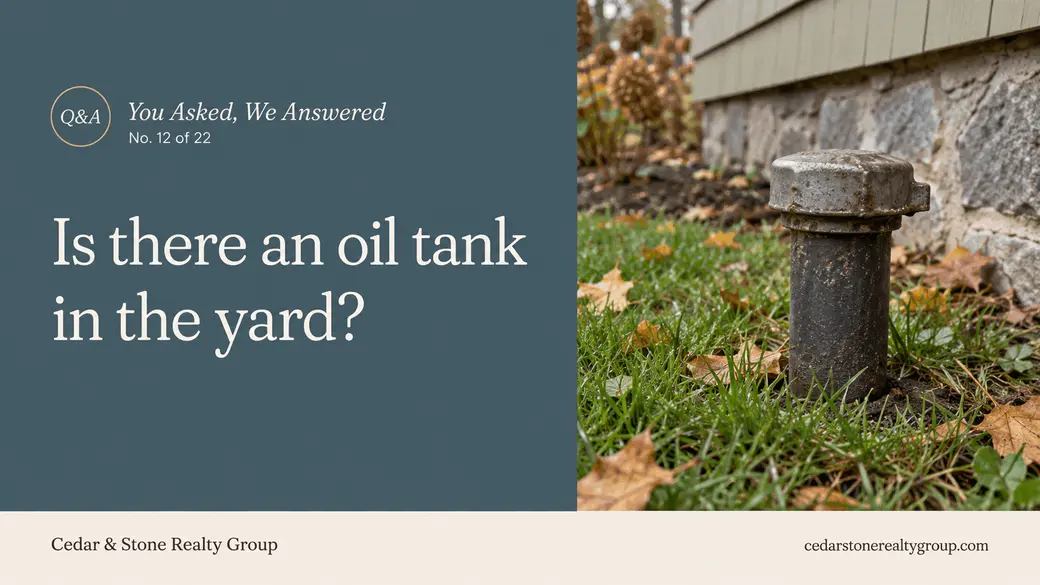
Question 12: Do I Need an Oil Tank Search Before Buying or Selling a Portland Home?
Short answer: if the home was built before about the 1970s, a tank search is cheap peace of mind for buyers and sellers alike. Many older Portland homes heated with oil before switching to gas or electric, and the tank didn’t always leave when the furnace did. Sometimes it’s still sleeping quietly in the side yard.
Clues a home once heated with oil
- A fill pipe or vent pipe sticking out of the ground or the foundation, often near a side yard or driveway.
- Copper lines coming through the basement floor or wall near the furnace area.
- An old furnace conversion, or a chimney that seems oversized for a gas appliance.
- A neighborhood full of homes the same age that had oil tanks. In Portland, that’s a lot of neighborhoods.
- Check Portland Maps permits for the home in question.
None of these proves a tank is there, and the absence of clues doesn’t prove it isn’t. Pipes get cut. Records get lost.
What a search involves
Records first. Ask the seller for paperwork. Then check permit records and the state’s heating oil tank records for any documented decommissioning or cleanup. Also, Oregon’s DEQ online database has records of decommissioned oil tanks.
Tank sweep. A specialist scans the yard with metal detection equipment to locate a buried tank. It’s fast and usually inexpensive.
Further testing, if a tank is found. Soil sampling shows whether oil has leaked. That result drives everything that happens next.
What “handled” looks like
A properly handled tank comes with paper. That usually means a tank that was decommissioned (emptied, cleaned and either removed or filled in place) by a licensed provider with documentation, and if there was a leak, a cleanup with a closure letter from the state. The paperwork is what buyers, lenders and future buyers want to see. A neighbor’s memory that “they filled it with sand in the 90s” is charming but not documentation.
How an unresolved tank affects the sale
- For buyers: an unknown tank is an unknown cost. Decommissioning is predictable. Obtain a quote for the decommissioning and potential clean up in the event the tank leaked. Costs vary based on the findings of the scan and soil samples.
- For sellers: a tank found during the buyer’s inspection period becomes a negotiation under deadline pressure. Finding and addressing it before listing gives you control over the timeline and the cost.
- For everyone: it’s common for a tank discovery to lead to a repair request, a credit, or a seller agreeing to decommission before closing.
My recommendation
Sellers of older homes: search before you list. Buyers: include a tank search in your inspection plan unless solid documentation already exists. It’s one of those small checks that prevents very large surprises.
Selling or buying an older Portland home? I can help you find the right specialist and figure out what the records already show.
Rules and procedures for heating oil tanks can change. Work with licensed tank service providers for evaluations and decommissioning.
Categories
Recent Posts