October Q&A Series Q20: The Home Backs to a Green Space. How do I know whether it can be developed?
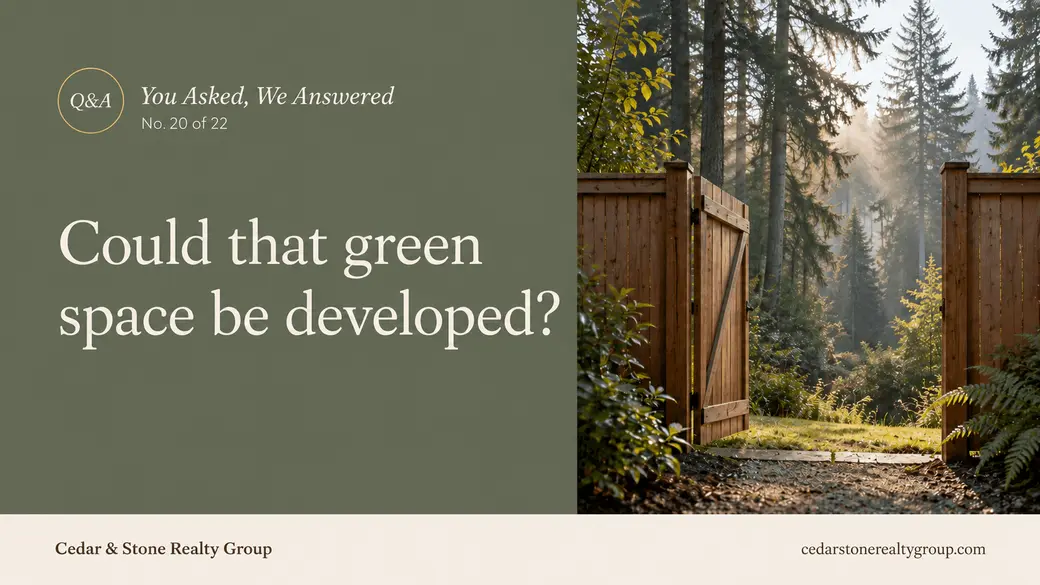
Question 20: The Home Backs to Green Space. How Do I Know Whether It Can Be Developed?
“Backs to greenspace” might be the most romantic phrase in a listing description. It’s also one of the most misunderstood. A forested lot behind a home can be permanently protected open space. It can also be someone’s future subdivision that just hasn’t happened yet. The trees look the same either way.
Four questions to answer
- Who owns it? County assessor records and mapping tools show who owns the parcel. A city parks bureau, a land trust or an HOA common tract is a very different situation than a private owner or a developer.
- How is it zoned? Zoning tells you what the land can be used for. Residential zoning means homes could someday go there. Open space or environmental zoning, or special overlays for streams, wetlands and steep slopes, can limit what’s allowed.
- Is anything recorded that protects it? Look for a conservation easement, a plat that designates the area as an open space tract, or a deed restriction. These are recorded documents, and they carry far more weight than a seller’s “oh, they’ll never build there.”
- Is anything already in the works? Check for pending land use applications, notices posted on the property, or recent neighborhood meeting notices. Development often announces itself on paper long before construction starts.
View versus protected open space
|
What you see |
What it might be |
What protects it |
|
City owned natural area |
Public park or natural area |
Public ownership, though uses can change |
|
HOA common tract |
Shared open space |
Plat designation and HOA documents |
|
Wetland or stream corridor |
Environmentally sensitive land |
Zoning overlays and state rules, which can limit but not always prevent building |
|
Large private lot with trees |
Undeveloped private land |
Often nothing permanent |
Where to look
Your title report and the recorded plat for the subdivision are a great starting point. City and county mapping tools show ownership and zoning. For anything unclear, the local planning department can answer questions about zoning and pending applications, and a land use attorney can interpret complicated restrictions.
Why it matters for value
A permanently protected view can be worth paying for. An unprotected one is a pleasant feature that may not last. Both are fine, as long as you know which one you’re buying and price it accordingly.
Falling for a home with a leafy backyard view? I’ll help you dig into what’s behind the fence before you pay a premium for it.
This post is general information, not legal advice. Land use rules vary by jurisdiction and can change.
Categories
Recent Posts